Cause 1
A partisan composition
Parties and the administration sat in the institution. Each camp defended its own interests there and the majority had a built-in advantage: the referee was also a player.
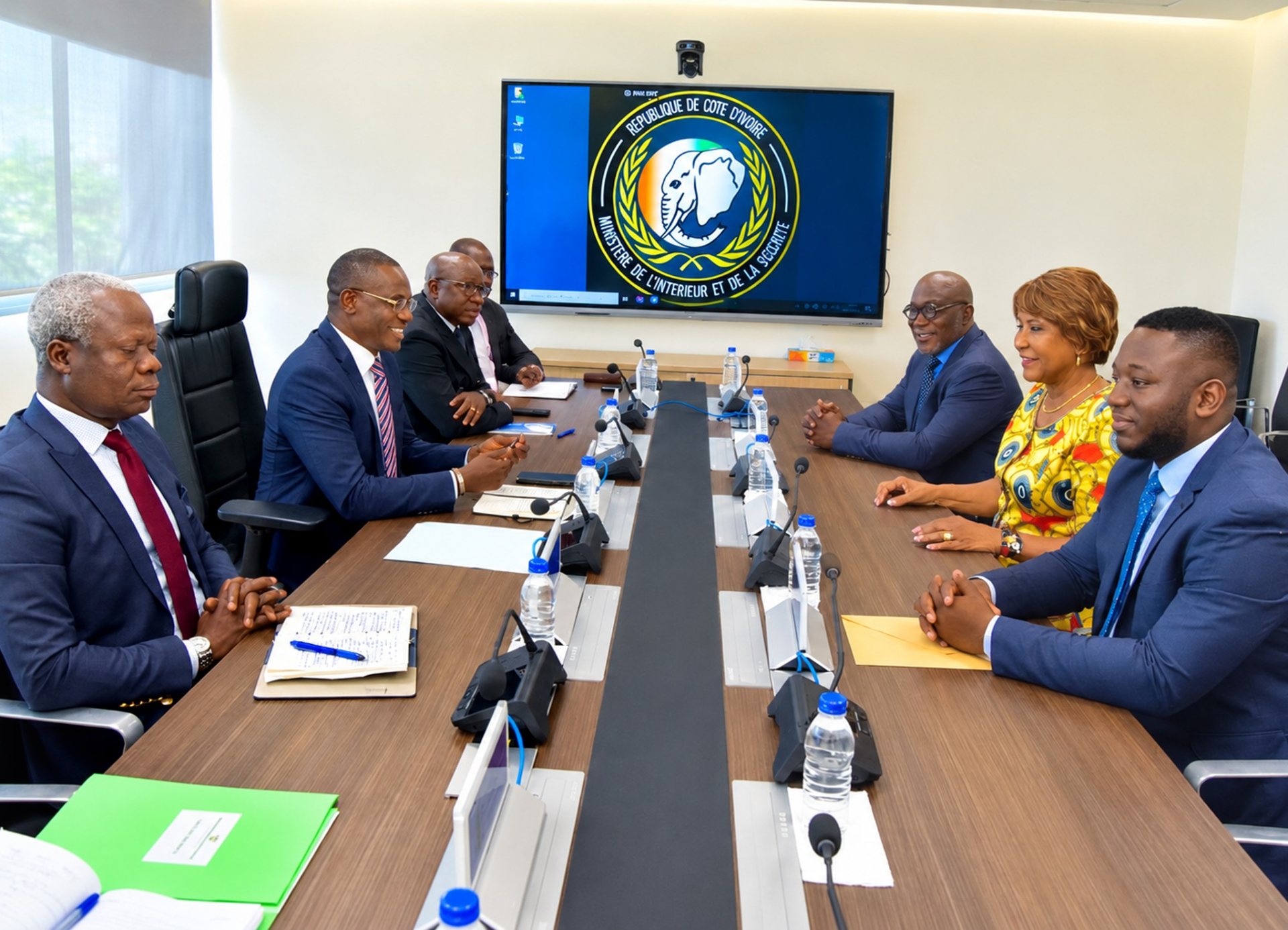
Photo: URD
Home›Electoral reform
Following the dissolution of the Independent Electoral Commission on 6 May 2026, the URD proposes entrusting the entire electoral chain to a single institution, led by civil society figures chosen in full public view. The proposal was handed to the Minister of the Interior and Security on 2 October 2026.
Since it was created by Law No. 2001-634 of 9 October 2001, the Independent Electoral Commission has never won the trust of all political actors. The URD identifies five causes of this failure; a new institution will only be credible if it corrects all of them at once.
Parties and the administration sat in the institution. Each camp defended its own interests there and the majority had a built-in advantage: the referee was also a player.
The institution depended on the executive for its budget and on the territorial administration for its operations.
Without a regular independent audit, every revision raised suspicions of irregular registrations or exclusions.
Polling-station tally sheets were not systematically published, station by station, which prevented any citizen oversight.
The 2010-2011 crisis, born of contradictory announcements by the CEI and the Constitutional Council, cost the lives of more than 3,000 Ivorians.
On 22 June 2026, the Prime Minister presented an architecture based on three separate bodies: the practical organisation of elections, voter registration and vote compilation, and supervision and oversight. The URD cannot endorse it as it stands and proposes a single institution covering all these areas under one accountable authority.
| Issue | Three-body architecture | Single institution proposed by the URD |
|---|---|---|
| Accountability | Diluted: each body can blame another for a failure. | Clear: one authority answers for the whole chain, from registration to the announcement of provisional results. |
| Appointments | Three sets of appointments, hence three opportunities for suspicion. | A single appointment procedure, public and open to citizen scrutiny. |
| Coordination | A continuous electoral chain broken into links, with grey areas between them. | Specialised departments within one institution, under a single board. |
| Method | Plan submitted without prior formal political dialogue. | Adoption preceded by an inclusive dialogue bringing together the government, parties, civil society and religious authorities. |
Guaranteed by the Constitution and by law: the institution takes instructions from no authority.
Under the supervision of no ministry, with its own budget set in the finance act and audited by the Court of Auditors.
Figures recognised for their integrity, competence and probity.
No representative of the parties, the executive or the administration sits on the decision-making body; state officials provide technical support only.
Deciding and executing are two separate functions. Seconded state officials report to the institution for the whole duration of their secondment and take no instructions from their home administration.
| Level | Who sits there | Role |
|---|---|---|
| Decision-making board | Civil society figures only | Decides, approves the voters' roll, announces provisional results |
| Technical services | Seconded state officials and neutral technicians recruited by competitive examination | Carry out operations under the sole authority of the board |
The board brings together complementary profiles, chosen for their competence and independence. Balanced representation of women is ensured.
At the end of the appointment procedure, the members themselves elect the institution’s chair from among their number. The chair’s legitimacy comes neither from the Head of State, nor from the government, nor from the political parties, but from their peers — which strengthens both their independence and the board’s cohesion.
For more than twenty years, CEI members were appointed behind closed doors, after bargaining between parties and institutions. Citizens discovered their names in the Official Gazette without knowing anything about their backgrounds or their convictions.
The URD proposes to break with this practice: no member of the future electoral institution could be appointed without first being heard in public. Transparency should not begin on election day, but as soon as those who organise the vote are chosen.


IllustrationPhoto: The Climate Reality Project / Unsplash
From the first call for applications to the appointment, every step is public and reasoned.
Published in the Official Gazette, in the press and in public media, with objective criteria: integrity, recognised competence, experience, no party membership or government post in the preceding years.
A committee made up of the President of the Court of Cassation, the Ombudsman of the Republic and the President of the Bar checks eligibility and draws up a shortlist.
Each candidate’s CV, declaration of interests and cover letter are made public; citizens, civil society and the press can report possible conflicts of interest.
Each candidate is heard by a balanced panel, live on television, radio and online, and also answers questions from the public.
Selected members must win a broad majority, so that no camp can impose its choices alone; the reasons for each decision are published.
Appointment is made by decree, with no possibility for the executive to change the selected list. The board then elects its chair.
To manage an operation as complex as a national election.
From parties, the government and economic interests.
From the voters’ roll to electoral disputes.
Wherever it comes from.
Ivorians will know who referees their elections and why they were chosen.
Someone without real competence, or tied to one camp, will find it hard to get through a public hearing.
Public statements of independence will remain on record and can be recalled throughout the term of office.

A sound appointment process is worthless if members’ status does not protect it. The URD proposal sets strict safeguards before, during and after the term of office.
The single institution takes on all the tasks currently spread across several actors.
| Task | Content |
|---|---|
| Organising elections | Logistics, polling stations, staff training, calendar, announcement of provisional results |
| Revising the voters' roll | An effective annual revision, registration of new adults and of the diaspora, reasoned removals |
| Auditing the voters' roll | An independent, adversarial audit before each national vote |
| Electoral boundaries | Proposing balanced constituencies based on public demographic criteria |
| Civic education | Ongoing awareness-raising among citizens, especially young people and women |
| Voter participation | Automatic registration at 18 and, eventually, compulsory voting |
The final 2025 voters’ roll counted 8,727,431 registered voters Published figure, for a population of about 29.4 million at the 2021 census To be confirmed with the INS. Even allowing for minors, a large share of Ivorians of voting age are not registered.
The URD proposes two steps: automatic registration of every citizen on coming of age, using civil registration and identification data; then, once registration is effective, compulsory voting introduced gradually, with justified exemptions and symbolic penalties.
The institution will also propose electoral boundaries based on published demographic criteria, revised after each census and submitted to the parties for their opinion before being adopted by law.
An irreproachable composition is not enough. The proposal makes every step verifiable.
Every polling-station tally sheet is scanned and published online in real time; no result can be announced unless it matches their exact total.
The provisional roll is online and posted at every polling place, with enough time to file claims and reasoned removals.
Its own budget voted in the finance act, paid on a legal timetable and audited by the Court of Auditors.
A consultation framework in which parties are informed, consulted and have access to data, without sitting or voting on the decision-making body.
Only the institution announces provisional results; the Constitutional Council rules on the basis of the published tally sheets and gives public reasons for any annulment.
No substantial change to electoral law in the six months before a vote without broad consensus, in line with the ECOWAS Protocol on Democracy and Good Governance (2001).

IllustrationPhoto: Teemu Paananen / Unsplash
The first is the condition for all the others.
Before any vote in Parliament, bring the government, all parties, civil society and religious authorities together around the plan.
Entrust independent experts with a full audit to correct its anomalies and ensure a calm climate.
Correct the imbalances between constituencies’ populations and the number of seats they are allocated.
Make the annual revision a legal obligation, scheduled and funded.
Public facts, each linked to its source (in French).
| Date | Step | Source |
|---|---|---|
| 6 May 2026 | The Council of Ministers dissolves the Independent Electoral Commission. | Fraternité Matin, 22/06/2026 |
| 8 May 2026 | The URD welcomes the dissolution and calls for a body entrusted to civil society. | Ouestaf, 08/05/2026 |
| 22 June 2026 | The Prime Minister presents a three-body architecture. | AIP, 22/06/2026 |
| 2 October 2026 | The URD President hands the party's proposal to the Minister of the Interior and Security. | Official URD report |
| 5 October 2026 | Several opposition parties hand the government a joint text on the future body. | Fraternité Matin, 05/10/2026 |
Parliamentary timetable for the reform: [not published to date]. This timeline will be updated at each step.
Côte d’Ivoire has paid too heavy a price for electoral crises to settle for a cosmetic reform. The aim is simple: after every election, the winner must be recognised and the loser must know why they lost.
The full text of the URD proposal — diagnosis, architecture, members’ status, remit, safeguards and recommendations — can be downloaded as a PDF (in French).